|
 |
| |
Technology development process |
| |
◎ Technology development support: The Next-generation Core Environmental Technology Development Project by
◎ Technology development support: Ministry of Environment (Korea Institute of Environmental Science and Technology)
◎ Technology development support: ※ Mar. 2007: Selected as an excellent project
◎ Technology development suppoㅍrt: (Recorded in excellent example case books of Ministry of Environment )
◎ Technology development Period: Jun, 2004 ~ May 2006
◎ Technology development Goal: Development of treatment system applicable to flow change characteristics of urban
◎ Technology d evelopment supp non-point pollution source |
|
| |
| |
Overview of FSF Technique (RainMasterTM) |
| |
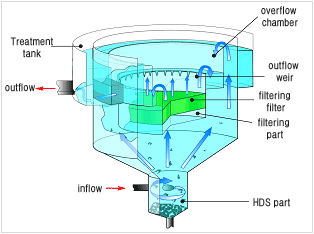
◎ FSF Technique is a non-motorized technique that combines HDS devices that use Vortex and filtering devices utilizing ◎ filter media.
◎ By installing HDS part utilizing Vortex on the lower part to eliminate relatively larger particles while installing a filter
◎ cell that uses filter media to eliminate miniscule particles that pass through HDS part. However, the most important
◎ element of this technology is that it places a great importance on maintenance and management by ensuring there
◎ would be no clogging in filter cells and by applying backwash process |
|
| |
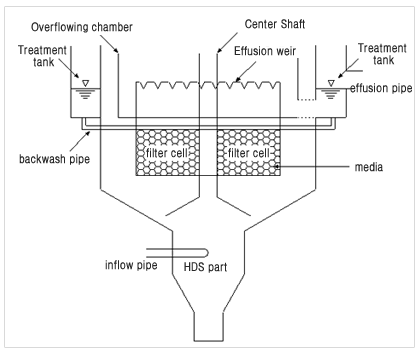 |
◎1. Rainwater run-offs flow in HDS part through inflow pipe.
◎2. Eliminate larger particles in HDS part through Voltex Flow
◎3. Treated water from HDS part filtered in filtering part
◎4. Release the treated water through effusion pipe
◎5. Release or store eliminated particles through Foul flow Outlet or store in storage tank
◎6. Filter Media의 backwash of filter media through treated water after cutting the inflow |
| |
| |
Treatment principle of FSF technique (RainMasterTM) |
| |
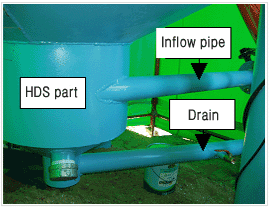
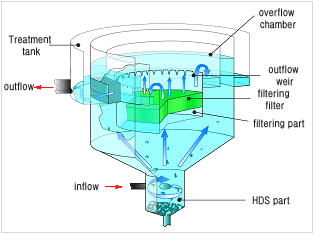
◎ During raining condition, rainwater flows into purification facility then goes through the first treatment at the HDS part
then treated at the filter cell then eventually released
◎ At the HDS part, Vortex (swirling current) eliminates relatively larger particles as circulating rainwater run-offs flow into
a tangential line then follow the HDS wall. |
|
| |
 |
| |
◎ At the filter cell, miniscule particles that pass through HDS part flow into the filtering part by upward flow then treated
◎ by filter media before being released |
◎ At the filter cell, when rainwater run-offs enters, filter media that are small in volume move to the upper part to start
◎ filtering process |
◎ When entered water exceeds the designed capacity, it is treated at the HDS part first then excessive amount of water
◎ is released over overflowing chambers |
| |
 |
| |
◎
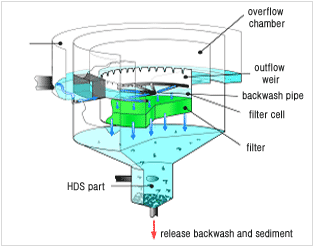
When rain stops, with the descending water level, filter media moves to lower position creating gaps among themselves
◎ and pollutants that have been caught within filter media washed off.
◎ After being cleansed by the movement of Filter Media, when the water level reaches a certain point, it carries out
◎ secondary cleaning by providing backwash water in the treatment tank by non-motorized water-level valve |
| |
 |
|
| In case of rainwater run-offs inflow |
- When rainwater run-offs enters, treated at the HDD part
first then filtered second before releasing water |
|
|
|
| |
|
| |
 |
|
| In case of backwash after rain |
- When inflow stops, water level in the tank declines
through a lower part drain then backwash takes place
through movement of filter media |
|
|
|
| |
| |
Quality of Filter Media and backwash process |
| |
◎ Quality of Filter Media
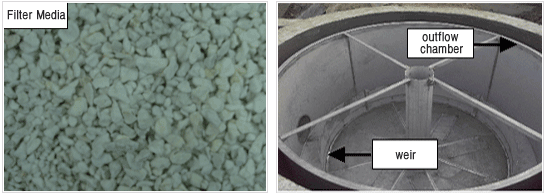
A small volume filter media such as Perlite. Depending on sites, appropriate hydrophobic filter media is selected.
As it is upward current type, it has higher self-backwash efficiency than other filter media. It also has a long period of
use. Filter media is provided in a cartridge so that it facilitates filter media replacement work.
◎ Backwash process After rain, when water inflow into the treatment device ceases, solid matters separated at the
lower part are transferred to sewage pipe and interceptor pipe, thereby lowering the level of water. - As the lowered
water level causes filter media that previously attached to the upper part of the filtering cell moves down to the lower
part and pores among filter media widens. As pollutants in the pores are washed off, the first backwash occurs.
When water level in the treatment device becomes lower than that of filter cell, the first back wash is finished and it
opens a water level valve. Then backwash water stored in the treatment tank is provided to filter media through
backwash pipes, the second backwash takes place. |
|
| |
|
| |
| |
Characteristics of FSF Technique (RainMasterTM) |
| |
◎ Developed to meet the characteristics of domestic non-point pollution source that tends to have drastic flow and
concentration changes
- Combine high efficiency slow treatment system and low efficiency high speed treatment system
◎ Capable of flexible response to changes in flow and concentration
- Improve the shortcoming of the existing system of fixed efficiency provided from high efficiency low speed, to low
efficiency high speed
- Create the optimum treatment efficiency according to changes in flow and concentration
- Relatively high treatment efficiency against high-speed treatment
◎ High treatment efficiency By reducing the diameter of the inflow, obtain the maximum circulating current (vortex) and
stabilize the flow at the upper part that has larger diameter, thereby achieving optimum particle elimination
- Eliminate miniscule particles by adopting upward current filters
◎ Less head loss
- As it has less head loss in high flow, it has great site applicability
◎ High selectivity of Filter Media
- Depending on site condition, it can achieve optimum treatment efficiency without filter media
- Select filter Media according to flow condition
- Use slope plate settling basin instead of Filter Media depending on site conditions
◎ Use long-term Filter Media
- Adopt upward current method
- Give pores to Filter Media to make self-backwash through the movement of Filter Media
- Planned to introduce non-motorized self backwash system
◎ Design (development) principle of FSF
- Maximum flow in the vortex of inflow water
- Maximum flow in effusion part
- Eliminate miniscule particles lower than 100㎛
- Eliminate floating matters
- Able to carry out unmanned operation based on non-motorized system
- Compact
|
|
| |
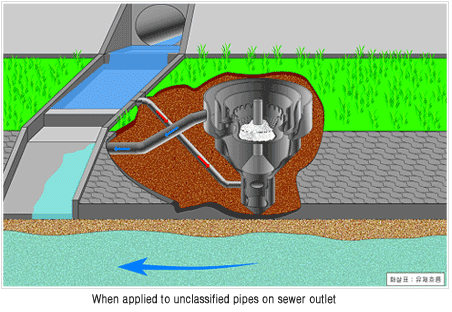
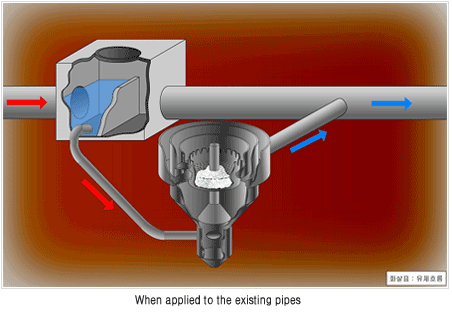
| Site application examples of FSF technique (RainMasterTM) |
 |
 |
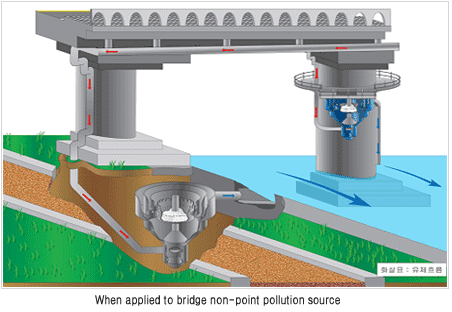 |
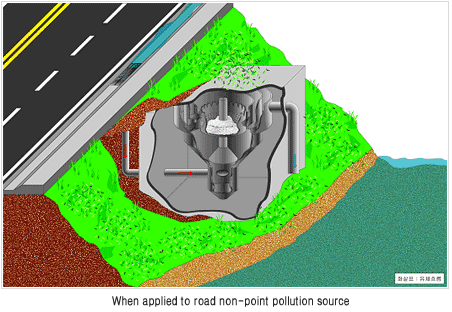 |
| |
| |
Maintenance of FSF technique (RainMasterTM) |
| |
◎ On normal occasions, check clogging state and sediments on pipes by naked eyes without special equipment
◎ If solar battery backwash process has been adopted, check the state of pump and storage battery.
◎ To determine a replacement cycle of the filter media, observe if filter media have been discolored to check filter part
and filter cell. If the color of filter media turns from its original color white to darker, it is deemed to be polluted
◎ The lower solid storage is a place where non-point pollution materials are separated and stored. After raining,
check by naked eyes if stored quantity is extensive, eliminate stored solids using a vacuum cleaning car.
|
|
| System in need of maintenance |
Maintenance methods |
Maintenance period |
Expected performance after maintenance |
| Filter part filter cell |
Replace Filter Media |
When excessive pollutants accumulate in filter media thereby increasing pollutant concentration and raising pressure loss |
Increase in treatment efficiency |
Inflow and outflow pipe
|
Wash out with high pressure water |
If inflow hole or outflow hole is clogged with sediments |
Smooth water flow |
| Solid storage tank |
Elimination of solid |
If solids are excessively stored |
|
|
<Maintenance method>
|
| |
 |
| Item |
Type |
Clients |
Remarks |
| Non-point Pollution Source Reduction Project for Nakdong watershed (pilot project by Ministry of Environment)- Gumi |
FSF |
Korea Water Resources Corporation |
installation completed |
00 business site’s non-point pollution source
treatment facility, Sooncheon-si
|
FSF |
00 business site |
installation completed |
| Sincheon natural river purification project |
FSF |
Dongdocheon-si |
Drawing execution |
Gwangju Urban area Non-point Pollution
Source Reduction Project |
FSF |
Gwangju, Gyeonggi-do |
Drawing execution |
Hwasoon (Dong-myeon~ Mt. Songgwangbong 1st, 2nd)
road extension work |
FSF |
Iksan Regional Land Office |
Drawing execution |
Incheon Chungra district Free Economic Zone
development project |
FSF |
Korea Land Corporation |
under review |
Cheonhae Shipyard business site Non-point Pollution
Source treatment facility |
FSF |
Shipyard |
designing |
| Buhang Agricultural/fishery road construction |
FSF |
Gwangju, Gyeonggi-do |
reflect basic design |
| Haeryong River natural river purification project |
FSF |
Sooncheon-si |
designing |
Namyang River Non-point Pollution Source Reduction
Project, Hwaseong-si |
FSF |
Hwaseong City Hall |
under review |
Environmental Impact Assessment for the development
of Buan special district for New and renewable
energy industry cluster |
FSF |
Buan Provincial office |
reflect impact assessment |
| Seongnam non-point pollution source Reduction Project |
FSF |
Seongnam City Hall |
reflect feasibility assessment |
Jeongwang Reservoir water quality improvement
and lake park creation project |
FSF |
Sihung City Hall |
reflect basic plant |
|
| |
Also, it is planned to apply this technique to Anyang River (Gunpo-si), Hong jae River (Dobong-gu, Seoul), Sihwa industrial complex (Korea Water Resources Corporation ), Yangjae River (Gangnam-gu, Seoul), Changwon River and Nam River (Changwon-si), Gulpo River Waterproof road
(Korea Water Resources Corporation ), 00 Complex creation project and many others |
| |
| |
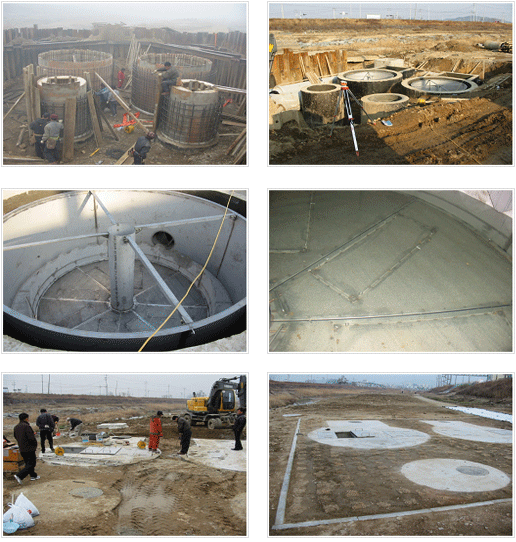
Pilot project of Nakdong River non-point pollution source Management facility (FSF, Gumi Sinpyong River, Korea Water Resources Corporation) |
| |
- Size: D3.6m × 5.0mH × 2 tanks
- Treatment capacity: 170㎥/40min(Design capacity)
- Treatment target: non-point pollution source (CSOs, road run-offs) flowing into Siinpyong River
|
|
| |
 |
| |
| |
| |
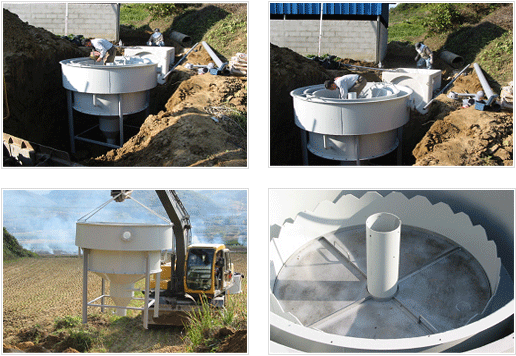
Suncheon-si (FSF, OO business) |
| |
- size: D2.3m × 2.8mH
- Treatment capacity: 1200㎥/d (1000m/d Surface loading rate in operation)
- Treatment target: non-point pollution source run-offs from business site road and parking lot
|
|
| |
 |
 |











 Home > Product > non-point pollution source field