|
 |
 Home > Product > non-point pollution source field
 |
|
|
| |
|
| |
 |
|
|
 |
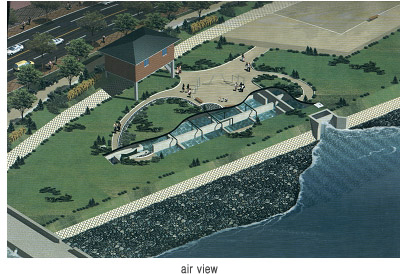 |
| While there are a lot of factors that contribute to aggravating water pollution in rivers, there has been no breakthrough in improving water quality. Thus it has been one of the driving forces behind continued efforts of R&D in this specific field.
Against this backdrop, Singang High Tech has developed Aerated String Contacted Oxidization (ASCO) technique that utilizes river’s own natural purification method to carry out more effective river purification works.
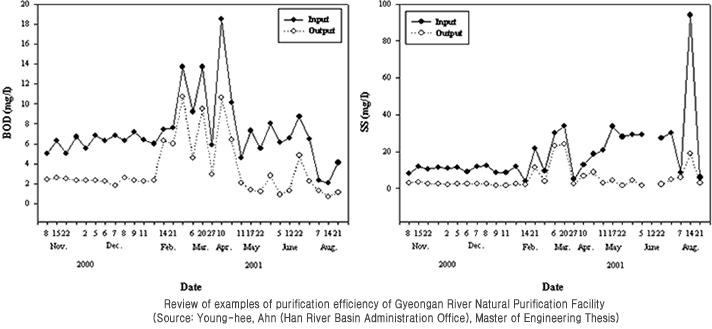
Aerated String Contacted Oxidization (ASCO) has been proved to have excellent purification efficacy as the results of our application to Gyeongan River, Dukso River, Yesan River, Sinyi River and Anyang River. |
|
| |
 |
 |
 |
| |
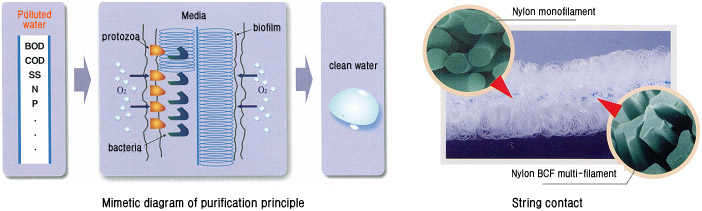
| Natural principle of river purification is to create biofilm on underwater gravels or grass roots in the river to oxidize and decompose. This technique is a biological treatment technique that utilizes microbes. First, string contact materials with increased surface area of bioflim is prepared then let polluted water in the river onto it so as to allow attached microbes to decompose pollutants. It is a high-efficiency treatment method designed as a conditional bio reactor to assist microbes to flourish and thus to decompose pollutants more effectively. What is central to this biocontactor utilized purification principle is the oxidization and decomposition of pollutants by microbes. Microbes involved in this process include bacteria, fungus, protozoa, Metazoa, etc. |
| |
 |
| |
 |
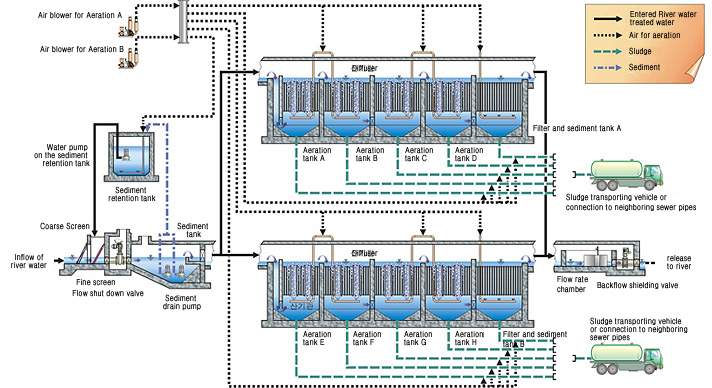
| This technique is composed of sediment and sediment retention tank, flow separation tank, aeration tank, filtering and sediment tank, sludge storage tank, etc. and its features are as follows |
|
Characteristics of the technique
1) Designed to use fabric bio contactor made up of nylon to increase surface area to be over 200㎡/㎥ (1.4㎡/m) to achieve
more than 75% BOD elimination efficiency and over 85% SS elimination efficiency in one-hour retention time.
2) Systemize the whole process in two different tanks to actively respond to external variation factors such as flood and to
achieve the optimum processing efficiency by varying operation conditions to use for basic data for future extension or
other river purification projects
3) Take oxidization process by microbes as the main elimination process and provide insufficient oxygen from outside to
maximize process efficiency while minimizing sludge generation through auto-oxidation. Also provide air in vortex method
by installing internal draught tubes to prevent sloughing of microbes on bio contacts with shearing force of air
4) Increased processing efficiency by dividing contact aeration tanks by each stage to compose a plug flow type
5) Install pyramid type pot on the bottom of contact aeration tanks to sediment and concentrate non-organic sludge and drain
high concentration sludge sloughed sludge at the bottom to release high concentration sludge.
6) Sedimentation tank only allows SS to sediment and regularly transfer SS to sediment retention tanks. Contact Aeration tank
keeps the concentration of dissolved oxygen at more than 3ppm to prevent corrosion and accumulate sludge on the bottom.
It eliminates the cause of odor by adopting a vacuum absorption type sludge pullout method. As a structure to erect bio-
contact, it uses SUS 304 to prevent durability decline by corrosion.
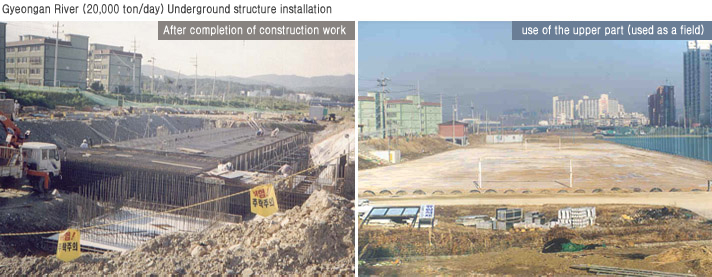
7) Improved hydrophilicity by establishing a park on the upper part of the processing facility |
|
Characteristics of biofilm
1) It has a variety of microbes involved in purification. Regardless of the staying time of river water, as there are creatures
with small non-proliferation rates, it increases the diversity of species. And a complicated feed chain helps to construct a
stable ecosystem. All of them contribute to an effective response to changes in environmental condition.
2) If we use a multilevel bioflim method, each level has different dominant microbes. Thus, it is very stable as it helps to create
a biofilm with the most dominant specie for water quality at each level.
3) As there is a higher proportion of animal substances in biofilm with a large presence of Metazoa, it allows high-level
nutrient creatures to reproduce. Thus it contributes to a longer food chain and large proportion of energy consumption,
leading to a smaller sludge generation
4) This technique allows microbes to multiply regardless of staying time, bacteria that have smaller non-prolification speed
such as denitrification bacteria and nitrifying bacteria. As the state of the interior biofilm is anaerobic, some denitrification
can take place. |
|
Treatment Characteristics
1) Though the quantity and quality of entered water change, they have no effect on the treated water. Even when the water
supply stops, as there are certain amounts of bacteria present through auto-oxidation, it can be normalized in a short time
when water re-enters.
2) If the temperature of entering water is low, as there are various microbes present, it sustains a diversity of bacteria, which
in turns produces higher treatment efficiency than othet techniques in low temperatures.
3) As there are a lot of miniscule animals in sloughing sludge, it is excellent in separating liquids without causing a bulking
phenomenon.
4) It is possible to treat low concentration water or high concentration water with more than BOD 80㎎/ℓ.
5) As it has long staying time as a solid, it produces less sludge. |
|
Purification capacity
1) BOD removal efficiency increases in proportion to staying time in a contact oxidation tank. For more than one-hour staying
time, the removal efficiency exceeds 70%
2) If the concentration of dissolved oxygen is consistent, the removal efficiency stays the same even if there is an increase in
concentration of entering water.
3) Among SS substances, quartz sand particles over 0.2㎜ are eliminated from sediment site at the inflow part while any non-
organic SS smaller than that collides with bio contactor to be settled down on a pyramid shape pot and concentrated. As
organic SS has low volume, it contacts a bio contactor by vortex then is absorbed and dissolved. In particular, organic SS
is likely to have minus electrodes, it tends to be easily drawn to nylon-based bio contactors that have plus electrodes.
Thus, this technique can remove more than 80% non-organic and organic SS
4) If the concentration of entering water is more than 40ppm, microbes that are more than 4,000㎎/ℓ attach in the form of VSS
and survive. Then nitrified N on the surface of aerobic bio-contactors goes through denitrification process within the
contactor. Its removal efficiency is around 30%. |
| |
 |
Specification
1) Material
- Ring: bio-contactor forming part
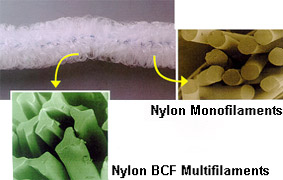
· 900 Denier 2-plied yarn, BCF Nylon multi-filament
· 600 Denier 4-plied yarn, Nylon monofilament
- Inner core: support contactors not to break down
· 4㎜ polypropylene rope yarn
2) diameter: 40~45㎜
3) surface area: above 1.4㎡/m
4) packing unit: 200m/box |
 |
|
| |
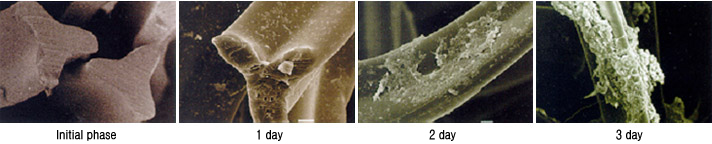
| Electron microscope Photos of Bacteria attachment for each phase |
 |
| |
Characteristics
1) Microbe attachment capacity of nylon yarn is superior to other materials
2) Its surface area is the largest (1.4m2/m) among available products and the largest diameter of 45¢ in Korea. It has high
MLSS content so that it is excellent treatment water quality while strong against impact loads.
3) The world’s first use of BCF of Y section. Excellent in initial microbe attachment performance and short period of time spent
on normalization.
4) For the same amount, it has about 5~10% higher efficiency for other rope-type fixed contactors.
5) As it is low in water passage resistance, it is unlikely to droop or break down.
6) Maximizes porosity to prevent anaerobic status and/or microbe sloughing
7) Semi-permanent . |
| |
 |
| Classification |
BOD(mg/L) |
SS(mg/L) |
Remarks |
| Inflow |
discharge |
Treatment rate (%) |
Inflow |
discharge |
Treatment rate (%) |
| Gyeongan River |
6.41 |
2.25 |
65.2 |
10.5 |
2.18 |
79.4 |
Oct.~Dec. 2000
Environmental Management Corporation |
| Anyang River (Gumjeong) |
13.5 |
3.0 |
77.8 |
19.6 |
2.9 |
85.2 |
Jun. 2003 Gunpo-si |
| 11.5 |
1.7 |
85.2 |
9.8 |
2.5 |
74.5 |
Jun. 2003 Gunpo-si |
| 7.17 |
2.34 |
67.4 |
19 |
5 |
73.7 |
Oct. 2004 Gunpo-si |
| Yesan River |
21.3 |
3.9 |
81.7 |
38.4 |
8.0 |
79.2 |
May. 2004Yesan-gun |
|
|
| |
| Classification |
T-N(mg/L) |
T-P(mg/L) |
Remarks |
| Inflow |
discharge |
Treatment rate (%) |
Inflow |
discharge |
Treatment rate (%) |
| Gyeongan River |
6.0 |
3.6 |
36.2 |
0.108 |
0.076 |
33.5 |
Oct.~Dec. 2000
Environmental Management Corporation |
| Anyang River (Gumjeong) |
6.94 |
5.36 |
22.8 |
0.21 |
0.24 |
- |
Jun. 2003 Gunpo-si |
| 11.9 |
3.7 |
68.9 |
0.39 |
0.148 |
62.1 |
Jun. 2003 Gunpo-si |
| 4.657 |
3.571 |
23.3 |
0.232 |
0.103 |
55.6 |
Oct. 2004 Gunpo-si |
| Yesan River |
16.3 |
13.5 |
17.2 |
0.85 |
0.68 |
20.0 |
May. 2004Yesan-gun |
|
|
| |
 |
| |
 |
| ※ Based on currently-operating key domestic and overseas facilities |
| Name of purification facility |
Gyeongan River |
Anyang River (Gumjeong) |
Dukso River |
Jeungah River, Japan |
purification Plan
(design specification) |
Planned water quantity |
20,000㎥/day |
16,500㎥/day |
8,000㎥/day |
259,200㎥/day |
| BOD(mg/l) |
10 → 3.5
removal rate: 65% |
20 → 8
removal rate: 60% |
20 → 7
removal rate: 65% |
10 →3
removal rate: 70% |
| SS(mg/l) |
10 →3
removal rate: 70% |
21 → 8
removal rate: 60% |
15 → 5.25
removal rate: 65% |
- |
| Facility specification |
Staying time |
1.0 time |
0.8 time |
1.0 time |
0.75 time |
| facility size |
L36m×W5m×
H2.1m×2tanks |
L63m×W4.0m×
H4.2m×2tanks |
L27m×W9m×
H4.5m×2tanks |
L7.5m×W6.75m×
H8.3m×60tanks×
20계열 |
| facility capacity |
910㎥ |
845㎥ |
589㎥ |
9,842㎥ |
| media |
String contactor (Ø40)
188.000m |
String contactor
(Ø45)
187,000m |
String contactor (Ø45)
188,000m |
Plastic media
String media |
|
|
| |
 |
At present, despite the efforts on drainage system maintenance and effusive water control, fundamental measures to improve water quality, there is no significant improvement in water quality. The causes are as follows:
First, a transitional phenomenon in which public policies such as drainage system maintenance fail to catch up with the increase in pollution sources
Second, direct inflow of sewage from settlement areas where it is not realistic to take proper drainage system maintenance
Third, sewage inflow from rainwater pipes in a place where drainage system is arranged in classified type pipe system as sewage pipe mixed with rainwater ones
Fourth, while the water level of river decreases during dry season, the increase in the area of impermeable layers by urbanization and the concentration of water use in urban area leads to a relative increase of urban displacement and difficulty in dilution effect by river flow.
Fifth, discharged water from the secondary treatment of sewer itself places a great load on river pollution. Though it can be remedied by introducing the third treatment, it requires proper drainage system maintenance. Thus it is hard to execute in short time as such a measure is expensive.
These reasons hinder the improvement of water quality in river. It is necessary to make some efforts on water quality improvement in river at the same time. A river purification system that uses string contactor meets the needs. It is an optimum natural purification technique developed to suit the characteristics of the river and is in operation in many rivers both in Korea and elsewhere.
In the future, it is expected that Aerated String Contacted Oxidization (ASCO) Technique will be an optimum alternative to improve water qualities in increasingly polluted rivers and lakes. It appears that this technique will have increasing demand to meet the needs of residents to secure a pleasant waterside and the will to improve water quality by Ministry of Environment and each regional government. |
| |
 |
Compared with other techniques, Aerated String Contacted Oxidization (ASCO) Technique ensures a great effect at low costs. To restore river to natural, it installs aquatic plants, shoal, march, etc. so it cleans the river through its natural purifying capacity. However, for rivers in urban areas or in a district that discharges large quantities of nutrient salts, the aforementioned method cannot obtain the expected water quality.
Aerated String Contacted Oxidization (ASCO) Technique can produce greater effect with lower costs than other techniques. One of the advantages of this techniques lies in the fact that it uses smaller required land and lower construction costs then others. The overall construction costs under general site conditions are as follows: |
| (unit: million won) |
| size |
expected construction costs (million won) |
required land (㎡) |
| Engineering work |
Machinery piping |
Electricity, Meters |
construction |
total |
Area of facility |
required area |
| 3,000㎥/d |
140 |
170 |
80 |
60 |
450 |
180 |
310 |
| 5,000㎥/d |
240 |
280 |
160 |
70 |
750 |
300 |
400 |
| 10,000㎥/d |
500 |
600 |
300 |
100 |
1,500 |
600 |
720 |
| 20,000㎥/d |
1,100 |
1,300 |
300 |
100 |
2,800 |
1,020 |
1,200 |
| 30,000㎥/d |
1,700 |
2,000 |
350 |
150 |
4,200 |
1,440 |
1,800 |
|
|
| |
※ Overall estimation is based on general site condition. In case of underground work, construction costs can be different
depending on site conditions or plans including additional facility construction costs such as land-side protection wall
construction, landscape creation according to park establishment plan, or installation of movable weir, etc.
※ Required area is an area that takes account of additional site for necessary area for facility에. |
| |
 |
| Classification |
Principles |
Characteristics |
Gravel
Contacted Oxidization method |
·Method that transforms rapids in river into gravels, marshes into a freshwater lake to increase efficiency 10 to 20 times
· Among gravels, flow is distributed over gravel surfaces to have several ㎜/s unit slow flow condition to achieve efficient liquid separation
· Separated sludge is gradually moved down to the lower part of the facility then stored |
· use gravels
· Water purification and a decrease in separated slime take place simultaneously · At first it has a great effect on BOD, SS but cannot purify ,T-N, T-P, etc.
· As it only uses DO in water, suitable for lower than 20㎎/ℓ
· Should have a solution to occlusion and change gravels every five years
· Purify lower than BOD4-6㎎/ℓ, SS10㎎/ℓ
· Upper part can be organized as a park |
Aerated String Contacted Oxidization
(ASCO) method |
· A method that complements the problems of Gravel Contacted Oxidization method
· Multiplying a number of microbes in aerated tanks to oxidize, absorb and attach
· It purifies matters that cannot be treated by Gravel Contacted Oxidization method and has a high purification efficiency
· Separated sludge is settled down to the bottom of the facility to concentrate |
· Use string contact media that has many times larger surface area than gravels
· water purification and volume decrease of biofilm take place at the same time
· Strong in variation of pollutant loads
· Able to purify most of BOD, SS, N, NH4-N, fungus, odor, etc
· As it uses aeration, it has a wide removal range of BOD (10ppm~100ppm)
· Able to use semi-permanently
· No problem with occlusion.
· Upper part can be organized as a park |
Aquatic plants
planting
restoration method |
· Method that uses plants to absorb T-N, T-P and sedimentation of SS to purify water |
· Requires large area
· While pollutant purification efficiency is relatively lower, it can discard T-N and T-P |
| Soil permeation method |
· Normal water flow rate of soil is around 0.5m/day it has a 10 times higher rate of 3-5m//day,
· Method that uses attach and filter through soil to purify |
· Requires SS removal by contact oxidization
· Able to eliminate chromaticity and phosphorus
· Occlusion recovery, chromaticity , reemitting of phosphorus, in other words, soil reclamation technology is important |
|
|
| |
| Classification |
Gravel Contacted Oxidization method |
Aerated String Contacted Oxidization
(ASCO) |
Aquatic plants
planting
restoration |
Soil permeation |
| Water quality |
Possible Water quality items to purify |
SS |
◎ |
◎ |
○ |
◎ |
| BOD |
◎ |
◎ |
○ |
◎ |
| NH₄- N |
|
◎ |
○ |
○ |
| E.coli |
○ |
◎ |
○ |
◎ |
| N |
|
◎ |
○ |
|
| P |
|
○ |
○ |
◎ |
| Fungus odor |
|
◎ |
|
○ |
| others |
|
|
|
◎ |
| Possible purified water quality level |
SS |
20-30 |
10-100 |
- |
|
| BOD |
10-30 |
5-100 |
- |
|
After purification
removal rate
concentration |
Removal rate
(%) |
SS : 70-90
BOD : 3-8 |
SS : 80-90
BOD : 70-85
T-N : 20-30 |
- |
SS 70-90
BOD 60-90
P 70-90 |
Purified water
(㎎/ℓ) |
SS : 2-3
BOD : 3-8 |
SS 2-3
BOD 2-5 |
- |
SS 1-3
BOD 1-3
P 0.002 |
Quantities |
1 ton/ daily construction costs
(Based on designing expenses, 10,000 won) |
0.2
(BELOW BOD20) |
0.06~0.1
(BELOW BOD20) |
- |
0.2 |
| Staying time |
1.3 hrs
(BELOW BOD20)
※FOR MORE THAN BOD20,
Staying time increase |
0.8~1 hrs
(BELOW BOD20)
※FOR MORE THAN BOD20,
Staying time increase |
3 day |
3-10㎡/㎥.d |
| costs |
1 ton/daily construction costs
(Based on designing expenses, 10,000 won) |
20~30
(BOD20이하) |
12~20
(BOD20이하) |
80 |
70 |
Maintenance costs per 1 ton
(won/year) |
1,000~2,000
(BELOW BOD20) |
700
(BELOW BOD20) |
- |
- |
| Maintenance items |
· Accumulated sludge management
· gravel replacement 1/5-6 years
· aeration tank sludge
1/3-6 months |
· sediment management 1/6 months· machine, electricity installation management |
· sediment management 1/6 months· machine, electricity installation management |
· Occlusion management
· Occlusion recovery management
(dig up soils to replace |
|
|
| |
 |
| |
Clients |
Construction work name |
Size (ton/day) |
Establishment date |
| 1 |
Environmental Management Corporation |
The natural purification facility installation work for Gyeongan River |
20,000 |
00,12 |
| 2 |
Gunpo-si, Gyeonggi-do |
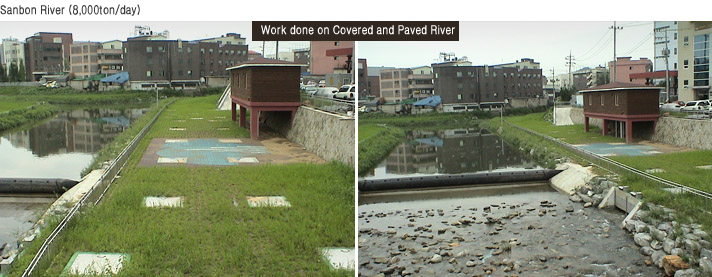
Polluted Sanbon River purification project |
8,000 |
01,07 |
| 3 |
Gunpo-si, Gyeonggi-do |
Anyang River downstream (Gumjeong District) polluted river purification project |
16,500 |
03,03 |
| 4 |
Yesan-gun , Chungnam |
Yesan River natural purification facility installation work |
2,000 |
03,12 |
| 5 |
Gunpo-si, Gyeonggi-do |
Anyang River Upstream (Dangjeongdong District) polluted river purification project |
12,000 |
04,12 |
| 6 |
Jinhae-si, Gyeongnam |
Sinyi River natural purification facility
installation work |
6,000 |
04,08 |
| 7 |
Jinhae-si, Gyeongnam |
Yeojwa River natural purification facility installation work |
3,000 |
under construction |
| 8 |
Cheonan-si, Chungnam |
Cheonan River (Seongjeong River) Water Quality purification facility installation work |
6,000 |
under construction |
| 9 |
Ulsan Nam provincial office |
Yeocheon River Water Quality purification facility installation work |
5,000x2sites |
design reflection |
|
|
| ※ Besides many other projects at designing stage |
| |
 |
| |
 |
| |
 |
 |
|
| |
|