| Classification |
Characteristics |
| Effects |
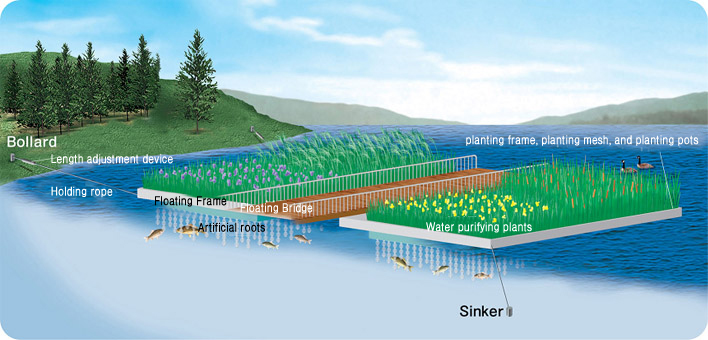
- eliminate organic substances and nutrient salts with water purifying plants and absorb sedimentation through roots, purify water by activities of root-attached microbes
-
Attach artificial string roots to respond to decreasing efficiency in the winter season, improve SS
sedimentation quality with artificial string roots and increase absorbing rates of phosphorus by
artificial root-attached microbes
-
Artificial string roots provides fish with a place to lay eggs and
-
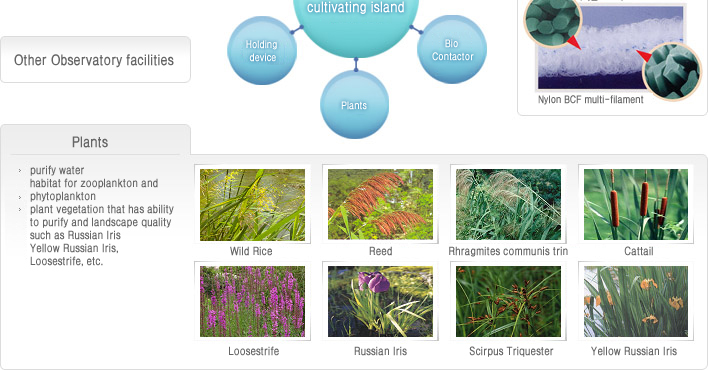
hide Provide a function as an ecosystem learning field with the floating bridge |
| Organic substance elimination |
- Growth of plants on the upper part
- Root-absorbing functions and biochemical action of attaching microbes
- Excellent in eliminating SS and turbidity by absorbing organic substances and colloid materials
with microbes that attach to artificial string roots and biofilm |
| Mineral absorption rates |
- Facilitate the absorbing capacity of plants and increase their growth by capacity to secure a
large amount of microbes by artificial roots and by quickly turning organic soluble phosphorus into
non-organic phosphorous that can be utilized by plants |
| Top-down control |
- As the number of zooplankton increased with the activities of microbes attached to artificial roots,
they ate up phytoplankton that causes eutrophication and became a source of food for fish |
| Fish ecosystem protection |
- As artificial roots provide fish with a place to lay eggs on them and to hide and offers a source of
food, they can replace insufficient fish spawning space while increasing the number of fishes |
| Stability of planting mat |
- Construct planting material basis with non-woven fabrics and polyester for planting
- As they are semi-permanent materials with strong resistance against wearing and corrosion,
they need no replacement and are economical |
| Stability of floating frame facilities |
- As STS materials are used to construct floating frame and facilities, they are strong against external
impact, stable with little problem associated with facility aging. |
| Scenic view |
- Possible to construct in a wide range of ways depending on planting vegetation and floating frame
processing methods
- Allow observation and field trip on the floating bridge installed inside of the facility and ensure the
beauty of the construction with its capacity for various forms |
| Learning activity |
- It allows residents or students to observe water ecosystem and planted vegetation right on the
floating bridge. At the inside, there are name tags with details of each plant. |
| Water Level response |
- As it connects the facility with ground bollard and water sinker made of concrete structures, then
calculates exact movements by the variation of ropes, it can withstand up to 30m water level change |
| Protection from wind/wave |
- As the roots are securely fixed with non-woven fabrics and vegetations are planted by punching
onto the polyester mat, it is stable with no worry of plants being rooted out
- With STS material structure, it is strong against external power and is solid
- As it combines unit based floating frame, no overthrowing by waves would happen |
| Facility maintenance and management |
- As it is constructed with STS material structure, there is hardly any need for replacement. The
floating bridge inside the facility offers a passage for maintenance and management while allowing
staff to carry out their work in safety |
| Applicability and examples |
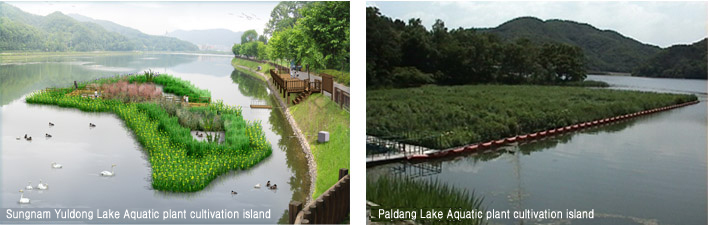
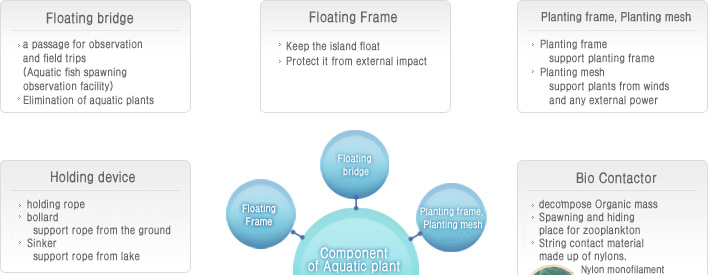
- By single or multiple combination of unit-based floating frame, it can have a variety of forms while
having no limit to any places such as parks, rivers or lakes. It also has the largest prior-installation
result in Korea (3,080m, Daechung Lake) and is currently installed in various sites.
- If it is installed in a large scale in a place where green algae appears plants can remove nutrient
salts and restrain the growth of green algae by shielding sunlight |













 Home > Product >Ecosystem restoration field