|
 |
 Home > Product >Ecosystem restoration field
 |
|
|
| |
|
| |
 |
|
|
 |
1) Definition of Seagrasses
| |
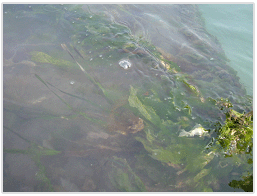
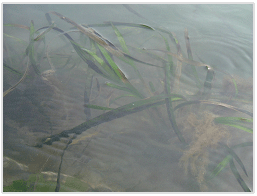
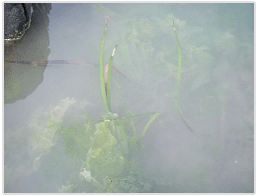
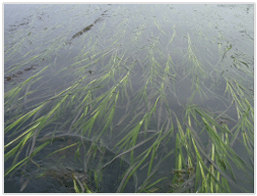
Seagrasses are aquatic species living in coastal and estuary zones and perennial maritime phanerogamous plants that belong to a monocotyledon plant class that grow, bloom and are pollinated in the sea. Unlike seaweeds, these plants develop vascular tissues and have distinguished roots, stems, and leaves. They grow in a place where they can absorb nutrient salts from the roots and create lush underwater forests in the coastal waters in the temperate and tropical zones. In an economic sense, seagrasses can be utilized as packaging or reinforcing materials. More importantly, however, it is one of the most important plant groups that has the highest productivity on the planet as a basic producer in coastal ecosystem and their organic products are incorporated into the upper nutrient level. Thus, they are not only closely related to maritime productivity of the coast but also construct a far-reaching ecosystem that provides habitats for various fish resources that have higher economic values as well as places to attach for various epiphytic algae. Also, they filter excessively-released nutrient salts or pollutants so that they improve water quality in the coastal area.
However, their habitats have declined by approximately 50% due to disruptions caused by human activities and environmental demolition of the habitats. Consequently, it leads to a shrinking maritime productivity in the coastal zone and in the diversity of maritime living resources, and to environmental disasters such as red tides.
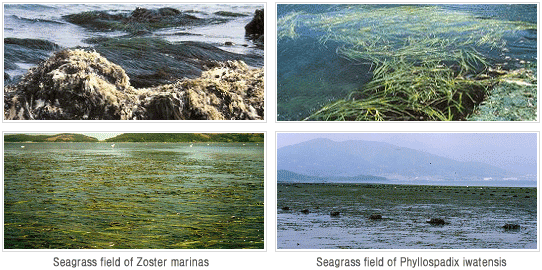
It is reported that in the Korean peninsula, there are two families and 7 classes of algae, which are comprised of 2 families of Phyllospadix iwatensis and 7 classes of Zoster marinas. Phyllospadix iwatensis in normal terms is called “Phyllospadix”; they live in rocks or solid grounds of the coastal areas in Donghae (East Sea), Namhae (South Sea) and Seohae (West Sea) while Zoster marinas, also called “Zostera” live in various places from lagoons, rivers, ports, basins where there is little influence from waves to widely open bays depending on their different classes. |
|
| |
 |
| |
2) Eco-geographic distribution and breeding environment of Seagrasse
| |
The eco-geographic distribution of Seagrasses in the entire coast of the Korean peninsula including Jeju Island appears as 14 peak points in the east coast, 11 peak points in the west coast, and 25 peak points in the south coasts and is often composed of single or two classes that create a seagrass field. The type of breeding site varies depending on the appeared classes and coastal zones.
Seagrasses in the Korean coastal areas appear in a range of breeding grounds including brackish water, ports in subtidal areas that are shielded from air with little influence from tides, area around ports, or wide bays in the coastal area. They are distributed from low water lines to shallow sandy water in 15 m depth and spread by underground stems to create a large colony like a field. Seagrass groups tend to be clustered around inner bays where tides are smooth so that the movement of seawater is relatively smaller than surrounding water zones. In addition, as seagrasses grow, they change the chemical characteristics of the area. |
|
| |
Table 1. Seagrass Habitats in Korea |
| Donghae |
Limited distribution in places such as ports or lagoons where tidal impacts are smaller |
- Gyeongsangbukdo (coastal areas around Dong-gu,
Buk-gu, Ulju-gun Wolsan Metropolitan City) |
| Seohae |
Mainly distributed in intertidal and subtidal areas around lslands |
- Incheon Metropolitan City (Baekryungjison in
Ongjin-gun, Daeyeon Pyongdo jison)
- Chungchungnam-do
(Taean Peninsula, Ouiyeon islands)
- Jeonlabuk-do
(Gogunsan archipelago, Byeonsan peninsula) |
| Namhae |
Widely distributed around all areas and it is conjectured that all seagrass classes around Korea are present in the area. However, it is not certain if there is Zostera Asiatica M. It is an area with most diverse seagrasses habitat in the world. However, it seems that there is no competition among different classes as their habitats do not overlap.
|
- Jeonlanam-do (Imhoe-myeon, Jindo-eup, Jisan-
myeon, Jodo-myeon, in Jindo -gun, Anjoa-myeon,
Sinui-myeon, in Sinan-gun, heojin-myeon in
Janghung-gun, Wando-eup, Sinji-myeon in Wando-
gun, Munnae-myeon, Bukpyeon-myeon in Haenam-
gun, Hwayang-myeon, Dolsan-eup in Yeosu-si,
Naeman coastal area in Gwangyang-si)
-
Gyeongsangnam-do (Seopo-myeon in Sacheon-si,
Samdong-myeon, Sulcheon-myeon, Yidong-myeon
in Namhae-gun, Noryangdaechijison, Changsun-
myeon, Dongdaeman in Hadong-gun, Yongwon-
dong, in Jinhae si)
- Busan Metropolitan city
(Songjeong-dong, Saha-gu, Gaduk-do)
- Cheju Island (Ozo-ri, Seongsan-eup, Hangwon-ri in
Gujwa-eup, Biyang-do in Hanrim-eup |
|
|
| |
| Table 2. Growth Environment of Seagrasses |
| Depth of Breeding ground |
0.8~8.0m |
| Salt distribution of the breeding ground |
8.0~34.2‰with euryhaline characteristics
With strong resistance against salts, they breed in groups not only in coastal ports but also in bays |
| Breeding ground’s pH |
8.3~8.6 |
| Concentration of nutrient salts in seawater in the breeding ground |
NO₂concentration |
0.08~0.29μM |
| NO₃concentration |
0.56~8.38μM |
| NH₄concentration |
0.53~4.77μM |
| Total Nitrogen (T-N)concentration |
24.3~69.3μM |
| PO₄concentration |
0.23~0.65μMv |
| Total Phosphorus (T-P) concentration |
0.61~2.26μM |
| Sediment in the breeding ground |
Mostly sandy area with some muddy sand area |
| Average granularity |
1.6~3.9 Φ |
| Average Organic substance contents |
1.5~8.9% |
| Moisture contents |
21.6~32.9% |
|
| |
| Table 3. Characteristics of Seagrass breeding grounds |
| Restrain soil basification |
While most inland soils are acidic, soils in newly-reclaimed areas around the coasts and those in seawater-encroached lands are often found to be alkaline. Places where seagrasses do not live tend to have stronger alkali as the water deepens. However the places in which seagrasses grow tend to have little change. |
| Electric Conductivity |
Compared with those places where seagrasses are absent, the areas that grow seagrasses tend to have higher EC (Electric Conductivity) that shows the degree to which liquid can carry electric currents |
| Organic substance contents |
The organic contents are higher in areas where seagrasses grow. This is because seagrass colonies tend to be created around inner bay areas where tide is smoother so that there is less chance for withered plants being carried away from the colony and mostly sink under the water in the colony. |
|
| |
3) Bio-seasonal characteristics of seagrasse
| |
In general, Zoster marinas, maritime phanerogamous plants create perennial fields through the growth in underground stems and the ramification of branches. Some of Zoster marinas in North America and Europe are annual plants. They might pass inappropriate seasons for breeding in forms of seeds then complete their life cycles within several months, then the entire individual plants including underground stems withered away.
As shown below, seagrasses’ growth was rapidly accelerated from February then started blooming at Wonpo-ri in Yeosu-si on March. In April, they had grown more than 50% in all sea areas. In May, they started to make seeds from fertilized individuals then they grew more than 95%, dropped seeds to the lower levels, and fertilizing stems fall from the rhizomes in June. In July they discarded most of the fertilizing stems and aged leaf blades while one-year-old leaf blades remained growing
After August, the overall growth slowed, then they discarded leaf blades that has impeded photosynthesis activities due to attached mud.
|
|
 |
| |
| |
| The bio-seasonal characteristics of seagrasses growing in the Korean peninsular shows the lifecycle of Zostera caespitosa clearly distinguished from that of Zostera nana Roth. Despite the fact that they grow mingling with one another, it is not likely to produce mutation due to their clearly distinguished life cycles. Based on their life styles, it shows that the initial appearance of Zostera caespitosa is a breeding ground with lower temperature than that of Zostera marina while that of Zostera nana Roth shows a possibility of evolving from the breeding ground with higher temperature than that of Zostera marina. |
| |
4) Role of Seagrasses in the coastal ecosystem
| |
- Provide abundant organic sediments and dissolved oxygen
- Use essential nutrient salts such as nitrogen and phosphorous to use as nutrient source for growth
- Absorb a wide range of heavy metals from the sea water then accumulate them in their leaf tissues
- Improve and ameliorate water quality by controlling the flow of seawater and suspended solids’ diffusion through
attaching to the individual plants
- Provide creatures places to attach to
- Offer habitats for fishes and invertebrates
- Underground stems in the ground prevent sediments from moving and stabilize them then provide oxygen in anaerobic
level
- Organic substances created by seagrasses serve as foods for many animals |
|
| |
A. Improvement of water quality by seagrasses
| |
Dissolved phosphorous and nitrogen are elements that have influence over the growth of seagrasses and are absorbed at the epithelial level of underground stems and leaves. As the amount of absorbed nitrogen is similar to that from soils with root tissues, seagrasses quickly absorb and eliminate excessive inorganic salts pouring from estuarine. They can also prevent an abnormal propagation of phytoplankton or harmful algae and reduce environmental disasters such as eutrophication and red tide.
In addition, seagrasses absorb a variety of heavy metals from seawater and accumulate in leaf tissues and improve water quality by controlling the flow of seawater and suspended solids’ diffusion by attaching to the individual plants |
|
| |
B.Create Spawning Ground by Seagrasses
| |
A seagrass field has a wide variety of animals and plants with high productivity and is one of the most prolific ecosystems, producing more than 10ℓ oxygen per unit area (m2), in the world. A seagrass field is used as the source of foods for fish and shellfish, as spawning and breeding grounds. About 3% of seagrasses are consumed by herbivores such as sea urchins and gastropodas and the rest of them create abundant organic sediments and dissolved organic matters after withering and decomposing. The dissolved organic matters are consumed by filter feeders attached to thallus of seagrasses while dissolved sediments serve to be a food source for various invertebrates. There is a huge variety of living creatures in seagrass habitats and they can be largely divided into 8 different species including attaching algae, attaching animals, benthos, invertebrate, fishes and soil microbes and reptiles such as sea turtles and mammalians such as dugongs or manatees. |
|
| |
 |
1) Ingredients for Experience |
A. Seagrasses (Zostera marina)
| |
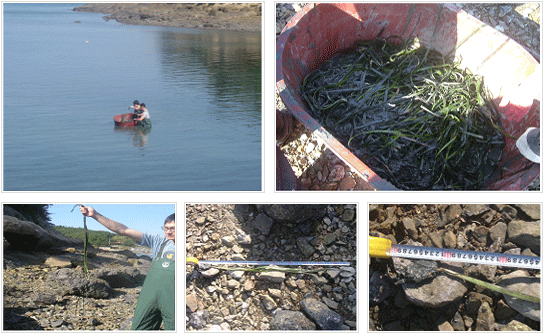
There are five Zostera marina classes and two Phyllospadix iwatensis in the Korean coast. It is conjectured that all seagrass classes live in Namhae coastal area. Zostera marina is one of the most widespread seagrasses in the world and is distributed throughout all coastal area of Korea. In Namhae coastal zone, it is widely distributed in all areas and creates broad fields compared with other classes.
This experiment uses Zostera marina habitats around Hwayang-myeon, Yeosu si, a pilot district.
|
|
| |
 |
| |
B. Floating-type seagrass cultivating device
| |
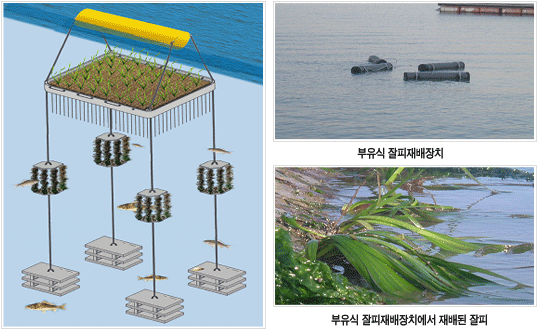
Floating-type seagrass cultivating device is a device that links seagrass cultivating beds to keep the same depth of water level with floats and crate artificial habitats for seagrass with a view to restore the surrounding ecosystem and provide habitats for economically valuable fish resources while reducing environmental disasters such as red tide. In addition, by installing artificial reefs on the lower part of the seagrass cultivating beds they offer spawning and dwelling places for fish and shellfish and restore ecosystems around coasts.
|
|
| |
 |
| |
| |
ⓐ A Composition and installation of floating type seagrass cultivating device
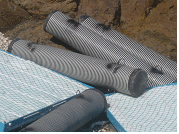
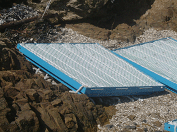
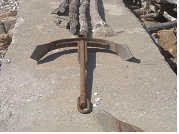
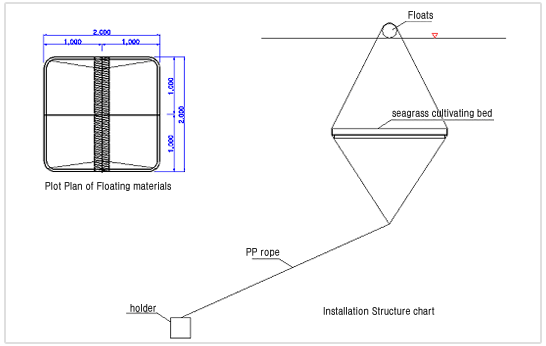
The floating-type seagrass cultivating device designed for this experiment is composed of floats to ascend to the surface of water by buoyancy and seagrass cultivating beds that artificially grow seagrasses, and holder that fixes them as shown in Fig. 1. After connecting them to maintain a 1m gap between floats and seagrass cultivating beds, moved the device and installed them with holders. Total four floating seagrass cultivating beds and each unit is linked by ropes to prevent loss from current. |
|
| Floats |
Seagrass cultivating bed |
Holder |
| PE double wall pipe, polyurethane |
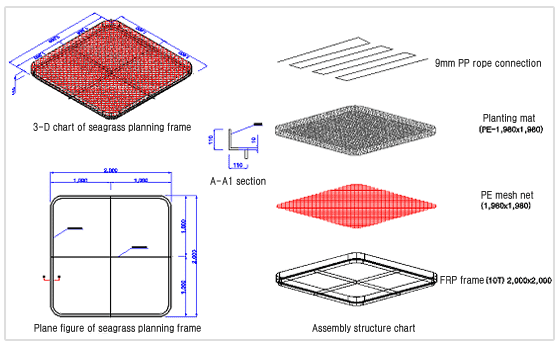
FRP frame, PE mesh net, planting mat,
PP rope, Media |
Anchor (50kg), PP rope |
 |
 |
 |
|
| |
 |
| |
Fig. 1 부유식 잘피재배장치 구조도 |
| |
 |
| |
Fig. 2 Structure chart of seagrass cultivating beds |
| |
| |
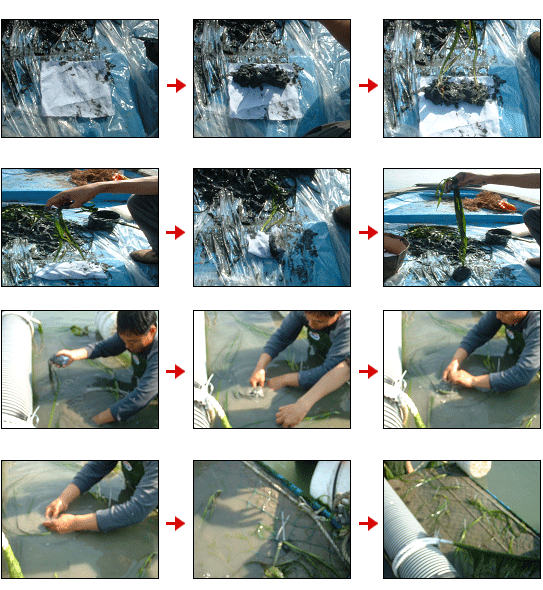
ⓑ Seagrass planting
Total 96 trees of seagrasses were planted. Before planting, we wrapped their roots with muddy soil and cotton
(or coir net) to grow well
① Prepare synthetic fibers and 100% cotton in size of 23cm×23cm
② Places muddy soil easily found nearby and seagrasses on the cotton
③ Wrap mud and seagrasses with the cotton so as not to be swept away by current
④ Wrap mud and seagrasses with *Coir net using the same method as above (cotton 48 trees, coir net 48 trees)
⑤ Plant wrapped seagrasses with cotton (or coir net) into the perforated mat
*Natural fiber extracted from the coconut husks |
|
|
| |
Fig. 3 식재 방법 및 순서 |
| |
2) How to monitor
| |
After installation we monitored four times over 21 weeks, mostly during low tide using the high water and neap tide when there is a large difference between tides |
|
| |
 |
1) The 1st monitoring (4 weeks after planting)
| |
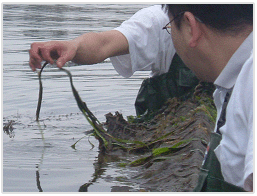
Monitoring 4 weeks after planting seagrasses into floating seagrass cultivating device (Nov. 11, 2004), it seemed that there was no seagrass loss but they failed to take roots in planting mats. Also there was no withered or dead seagrass. |
|
| |
|
| |
2) The 2nd monitoring (11주 weeks after planting)
| |
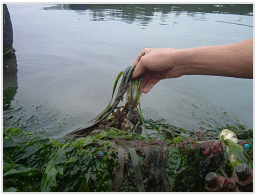
On January 27, 2005, 11 weeks after planting seagrasses, we found that cotton wrapped seagrasses mats have larger macrophyte attached than the coir net mats. It seems that as seagrass inhabits sandy mud, it was easier for it to settle down in coir nets which have net structure but in more dense cotton it failed to take root and attracted more macrophyte |
|
| |
|
| |
3) The 3rd monitoring (15 weeks after planting)
| |
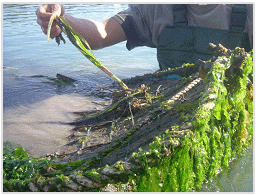
At the 3rd monitoring, we found seagrasses planted with coir nets took roots in planting mats. As for cotton-wrapped floating seagrass cultivating device, there are more macrophyte than seagrasses, appearing that there was not enough room for seagrass to live. Also it was observed that seagrasses within 10 weeks still survived but failed to take roots in planting mats |
|
| |
|
Mat in which seagrass roots
were wrapped in cotton |
Mat in which seagrass roots
were wrapped in coir nets |
|
| |
4) The 4th monitoring (21 weeks after planting)
| |
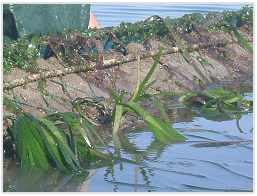
Seagrasses start growing in March and its growth accelerates in April. The 4th monitoring result showed that as seagrasses growing around floating seagrass cultivating devices started to grow fast, artificially-planted seagrasses gradually withered away. It seemed that as seagrass absorbs growth-affecting elements from soil and seawater through underground stems and epithelial cells on leaves, the artificially-planted seagrasses could not absorb nutrients from soil thereby withering away. Also with the rapid growth of surrounding seagrasses, inorganic salts such as phosphorus and nitrogen were promptly absorbed, the artificially-growing seagrasses could not secure enough nutrients to propagate. |
|
| |
|
Artificially Planted seagrasses |
Seagrasses inhabit around the floating seagrass cultivating device |
|
| |
| |
References
1) Sang-ryong, Lee, Yong-bae,Seo, Sang-tae, KIM, Jeong-il, Choi, 'Research on the form and ecological features of
Korean Zostera caulescens Miki', Ocean and Polar Research, Vol.24(4) 345-357, (2002)
2) Mee-hee, Jeong, 'Ecological research on attaching algae on seagrasses', Department of Earth and Marine Science,
Graduate School of Hanyang University , Masters thesis, (1997).
3) Seong-hee, Huh, Yong-rak, Ahn, 'Seasonal variation of Brachyura colony living in seagrass field in Gwangyang bay',
J.Korean Fish.Soc., 31(4), (1998)
4) Seong-hee, Huh, Sok-nam, Gwak, 'The food habits of sea basses living in seagrass field in Gwangyang bay ',
Bull.Korean Soc.Fish.Tech., 34(2), (1998)
5) Seong-hee, Huh, Sok-nam, Gwak, ‘The food habits of Globe fish fry living in seagrass field in Gwangyang bay’, J.Korean
Fish.Soc. 31(6), 1998
6) Seong-hee, Huh, Sok-nam, Gwak, ‘The food habits of Conger eels living in seagrass field in Gwangyang bay’, J.Korean
Fish.Soc. 31(5) 1998
7) Seong-hee, Huh, Sok-nam, Gwak, ‘The food habits of gobies fry living in seagrass field in Gwangyang bay’, J.Korean
Fish.Soc. 32(1), 1999 |
| |
 |
|
| |
|