|
 |
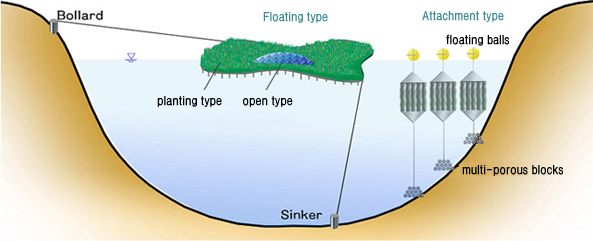
This technology is a fish-spawning facility designed to be installed in a dam, lake or reservoir where there are no weed beds, thus providing fish with a place to spawn and protect fish living in the lake and prevent their numbers from declining. |
| |
 |
| Types of facilities (categorized by application method) |
| Attachment type |
Floating type |
| Open |
Planting/open/ combination |
Respond to water-level by floating balls
(Form of ground blocks) |
Respond to water-level by floating frame
(able to respond to over 30m water level changes) |
| |
| |
 |
| |
 |
 |
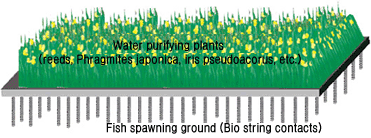
Plant water purifying plants such as reeds and yellow Russian irises on the upper ground to induce a range of effects including sunlight shielding, habitat creation, water quality improvement, aesthetic view improvement, etc. while attaching fish spawning facilities using biostring contacts on the lower part. |
|
|
Characteristics and Expected Effects
-
Control ecosystem
(provide fishes to spawn, live and hide)
-
Increase the food source for fish by creating an
environment in which plankton can flourish
-
Improve water quality through plants and bio contacts
-
Prevent green algae forming in the lake with its
sunlight-shielding effects
-
Prevent the corrosion of facilities in the fish spawning
ground by shielding sunlight (permanent)
-
Improve landscape on the lake
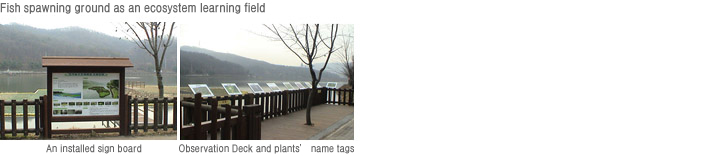
- Offer a function of ecosystem learning field with the
installation of a floating bridge |
 |
|
|
Installation examples
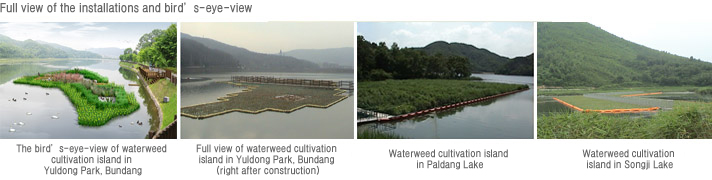
- Paldang Lake, Daecheong Lake, Paro Lake, Songji Lake, Whajinpo Lake, Sangsa Lake, Uiam Lake and many others |
| |
 |
| |
 |
| |
 |
Unlike the planting type, it does not have water-purifying plants on its upper part and only installs fish spawning devices on the lower part to protect fish while raising spawning rates. It is advantageous in case the purpose of installation is solely directed to an increase in spawning rates for a low price and when relatively less importance given to landscape. |
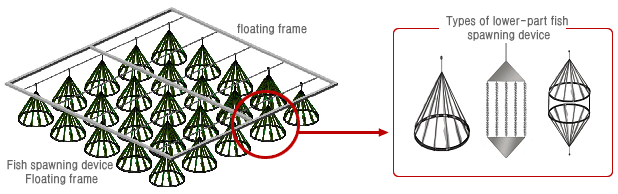 |
Characteristics and Expected Effects
- Provide a place for fish to attach eggs and to hide with lower part fish
spawning devices
- Increase the spawning rates of fish eggs by allowing sunlight to penetrate
- Economically more advantageous than planting type
※ Fish spawning device is installed with a structure that hinders the access of
adult fish and natural enemies so that it maximizes the survival rate of hatched
fry
in the spawning obstacle |
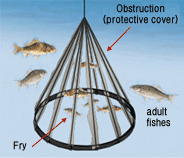 |
|
| |
 |
| It is ideal as it combines form of planting and opening types thereby increasing the source of food for fish with increased plankton, raising the spawning rates of fish with water quality improvements by water-purifying plants and the penetration of a certain amount of sunlight, and improving overall landscape |
| |
Characteristics and Expected Effects
-
With the combination of planting and opening types,
it achieves an optimum form
-
Improve landscape around the lake and control
ecosystem
- Create a condition that allows a partial penetration
of sunlight thereby providing energy necessary for
fish spawning
Application Examples
-Imha Lake, Soyang Lake, Tamjin Lake fish spawning
device (Korea Water Resources Corporation) and
many others |
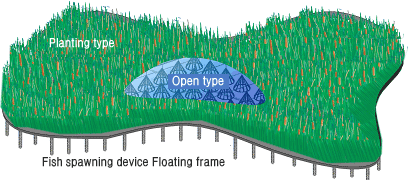 |
|
| |
 |
 |
| It is available for dam slopes, reservoir inflow area, and shallow river grounds where there are no weed beds for the spawning and dwelling of fish. It attaches fish spawning devices onto floating things to provide fish places to spawn and live. In addition, it provides a spawning and dwelling ground for indigenous benthic fishes such as eels, catfish, and Korean bullheads as it is connected to multi-porous blocks on the ground. |
| |
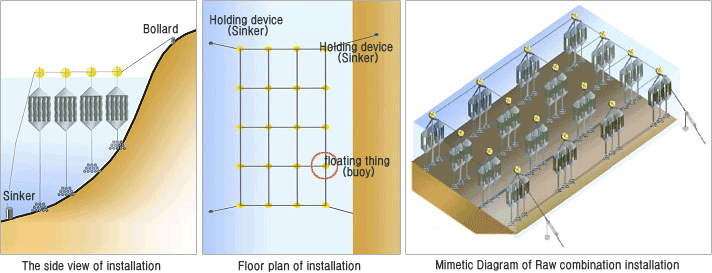 |
| |
Characteristics and Expected Effects
-
Possible to use in shallow river ground, river or dam slopes
-
As multi-porous blocks are attached to the ground, it provides a spawning and dwelling ground for indigenous benthic
fishes such as eels, catfish, and Korean bullheads that live in a pile of stones
- Provide place for fish to spawn and dwell and protect them from larger fish (provide a shelter) by artificial reefs. |
 |













 Home > Product >Ecosystem restoration field


